"I did everything right."
"I gave this company the best years of my life."
"I always put the company ahead of my family."
And yet: "I'm out."
These are the sentences executives bring to a first conversation after an exit. They are rarely about the job itself. They are about a contract the executive believed was mutual — loyalty for security, sacrifice for recognition — and discovered was not.
This article does not examine why exits happen. It examines what happens after: the grief no one budgets for, why the popular model of it misleads senior leaders, and how to know when it is genuinely over.
Three exits, one loss
Executive exits come in three forms. The labels differ; the loss underneath does not.
| Exit | How it is announced | How it is lived |
|---|---|---|
| Termination | "We are letting you go." | Shock, often public, rarely ambiguous |
| Negotiated exit | "By mutual agreement, X has decided to pursue new opportunities." | A termination in better clothes, with a script attached |
| Resignation | "I have decided to move on." | A chosen loss that still has to be grieved |
The negotiated exit deserves particular attention. In most cases it is simply a termination with a settlement and a press release. Its distinguishing feature is not the package. It is the agreed narrative the executive must now repeat in public.
Throughout this article, three composite executives illustrate the patterns we see most often in practice:
- Laurent, the Loyalist — 20 years with the group, terminated eight months after an acquisition.
- Hélène, the Signatory — COO, exited by mutual agreement with a strong package and a polished story.
- Daniel, the Leaver — resigned after 15 years to "take back control", and was blindsided by what came next.
Composite profiles, drawn from multiple client situations. Names and details are illustrative.
01 — The loss is bigger than the job
An executive does not lose a job. They lose five things at once, and the salary is usually the least painful of them.
The job title is only the visible part. Underneath it sit five distinct losses, each with its own symptoms and its own recovery time.
| Loss | What disappears | How it shows up |
|---|---|---|
| Identity | "Who am I without this role?" | Struggling to introduce yourself at a dinner party |
| Status | Deference, access, the returned call | Noticing who no longer answers within the hour |
| Tribe | The team, the peers, the shared enemies | A sudden, disorienting quiet |
| Structure | The calendar that decided your days | Unstructured Mondays that feel heavier than full ones |
| Security | Income and a visible future | Anxiety about money, even with a solid package |
For senior leaders, identity is almost always the deepest wound. Twenty years of being the person who decides do not dissolve with a signature. Laurent described it precisely: "I didn't miss the work for months. I missed being Laurent from the group."
The Leaver feels every one of these losses too. Daniel chose to go, so he believed he had no right to grieve. Psychologists call this disenfranchised grief: a loss that is real but not socially recognised, and therefore not mourned. It does not disappear. It goes underground and resurfaces later, usually at the worst moment.
STRATEGIC PROMPT Rank the five losses by how much each one still costs you today. The top one is where your work starts — and it is rarely the one you would mention in an interview.
02 — Why the stage model misleads
Grief does not run in a straight line from denial to acceptance. It swings back and forth — and for an executive in transition, that swinging is not a malfunction. It is grief doing its work.
Most leaders know the five stages: denial, anger, bargaining, depression, acceptance. The conventional career transition industry uses them, HR teams teach them, and they are a genuinely useful vocabulary. They are also widely misread.
Elisabeth Kübler-Ross developed the model in On Death and Dying (1969) from interviews with terminally ill patients facing their own deaths. It was never a study of bereavement, let alone of job loss. She later regretted that the stages had been read as a linear, predictable sequence. Her co-author David Kessler went further, adding a sixth stage — finding meaning — in 2019.
The practical danger for executives is the checklist mindset. Leaders are trained to move through phases and close them. When anger returns in month four, after "acceptance" in month two, they conclude they are failing at grief. They are not.
Grieving and rebuilding at the same time
A better fit is the model developed by Margaret Stroebe and Henk Schut in 1999. It describes two modes of coping that run in parallel:
- Loss-oriented — confronting what is gone: replaying the board meeting, missing the team, feeling the anger.
- Restoration-oriented — dealing with what comes next: updating the CV, taking calls, building a new routine.
Healthy coping means oscillating between the two. A morning spent drafting outreach messages, an evening spent furious about the restructuring memo: that is not regression. That is exactly how it is supposed to feel.
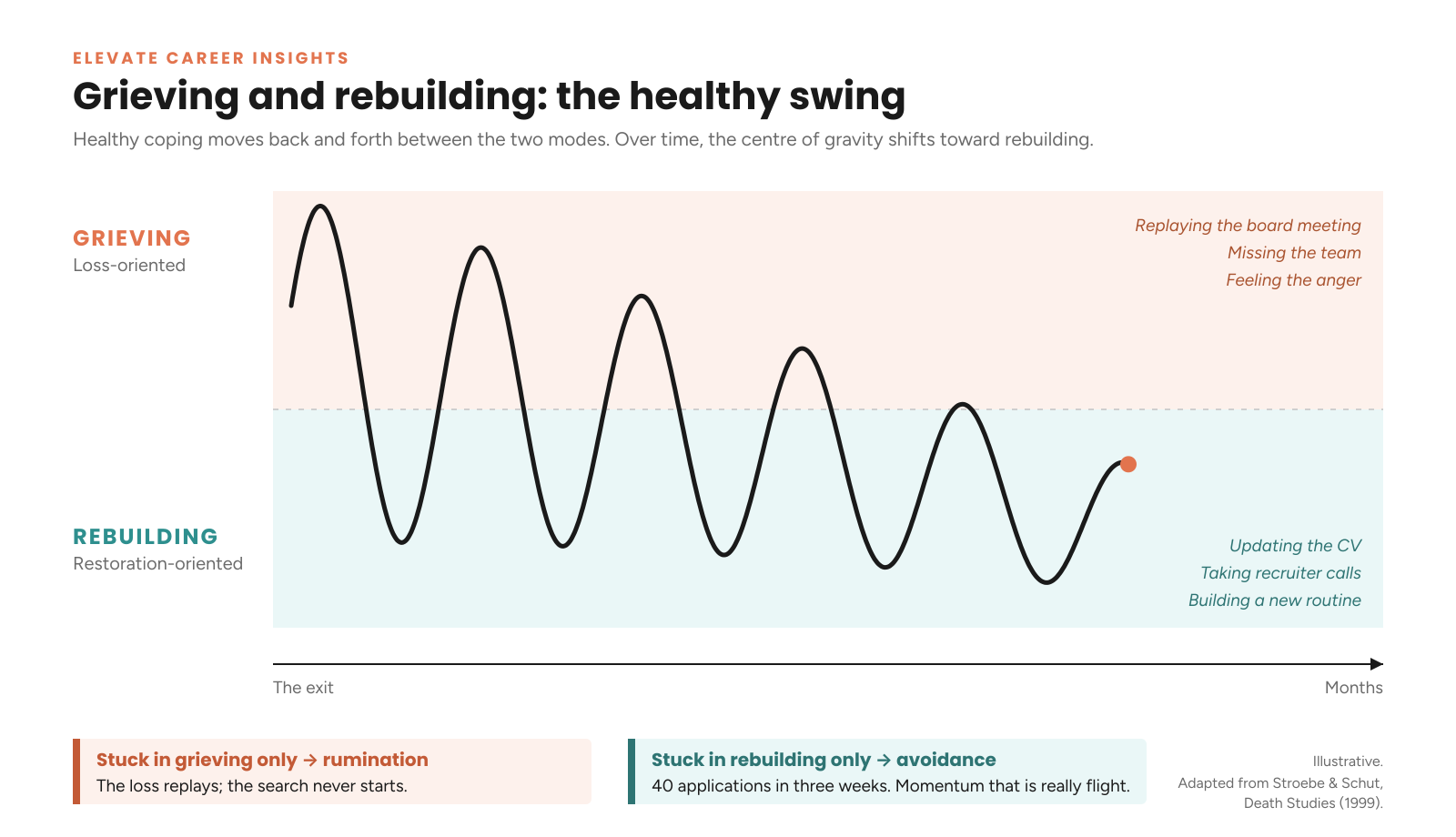
The risk lies at either extreme. Stay only in loss, and you ruminate. Stay only in restoration, and you are running from the grief rather than through it. Hélène sent 40 applications in her first three weeks and took every networking coffee offered. It looked like momentum. It was avoidance in a well-cut suit.
There is an old image for this. You cannot swing to the next vine while still gripping the last one. Hold both, and you hang in mid-air: present in interviews, still living in the old role. Grief is the letting go; the search is the reaching forward. Both are required, and the order matters less than the rhythm.
STRATEGIC PROMPT Look at the last seven days. How many hours went to loss, and how many to restoration? If either column is close to zero, that is your signal — not the stage you think you are in.
03 — The unfinished termination
Many executives arrive in our practice grieving two exits, not one. The current exit reopens an earlier one that was never fully digested — sometimes ten years old or more.
Laurent's reaction to his termination was out of proportion, and he knew it. The anger was too hot for a restructuring he had seen coming. Three conversations in, the real story surfaced: at 41, he had been pushed out of his previous company after a merger. He had moved on fast, landed well, and never looked back. Thirteen years later, the second exit was carrying the weight of both.
This is one of the most common patterns we see, and one of the least discussed. An undigested exit does not fade. It waits.
Why negotiated exits are the most likely to stay unfinished
The negotiated exit creates a specific trap. The settlement comes with an agreed announcement, a communication protocol and often a confidentiality clause. The executive is required to repeat a story — "I decided it was time for a new challenge" — to colleagues, recruiters and, eventually, to themselves.
The result is denial with a contract behind it. You cannot grieve a loss you are publicly committed to describing as a choice. Hélène told the story so often, and so convincingly, that she stopped noticing she had never felt anything about it at all.
Signals that an old exit is still open
- The former boss's name still produces heat, years later.
- The story of that exit takes five minutes to tell when it should take one.
- You avoid a company, a sector or a city without a business reason.
- You overcorrect: blind loyalty to the next employer, or a cynicism that treats every employer as a future betrayer.
STRATEGIC PROMPT List every exit in your career, chosen or not. Tell the story of each one out loud in 60 seconds. Notice which ones run long, which ones you rush, and which ones you would rather skip. That is your map of unfinished business.
04 — Agency without self-blame
In our practice, the strongest predictor of a complete recovery is taking ownership — not of the decision to let you go, but of the story you now tell about it.
Most executives explain their exit entirely through external forces: the crisis, the acquisition, the new CEO, the cost-reduction plan, the reorganisation. Very often, they are right. Structural exits are real — see The Strategic Casualty — and senior roles disappear for reasons that have nothing to do with performance.
But an explanation that is entirely external has a cost. If nothing was yours, nothing can be learned, and nothing in the next role can be done differently. The executive is left a passenger in their own career. That is a heavier burden than any share of responsibility.
Ownership is not fault. The aim is not to find what you did wrong. It is to separate what was yours from what was not, so that you can put down what was never yours to carry.
ELEVATE FRAMEWORK — The Attribution Split Every exit sits between two archetypes: the Performance Casualty, exited for reasons about the individual, and the Strategic Casualty, exited for reasons about the organisation. Placing your exit is the first step. The second is The Three Ledgers: sort every element of the exit into one of three. Mine: the signals I saw and discounted, the alliances I neglected, how long I stayed after I knew. The organisation's: the strategy, the restructuring, the politics, the way it was handled. Chance: the timing, the market, the new shareholder no one could have predicted. Nothing belongs in two ledgers. Only the first one is yours to work on.
The same logic resolves the question of who left whom. Daniel resigned; Laurent was terminated; Hélène negotiated. In the market eighteen months later, that distinction matters far less than they think. What matters is who is steering now. A terminated executive who has done this work is in a stronger position than a resigner still telling the story of an escape.
STRATEGIC PROMPT Write the three ledgers for your own exit. If the Mine column is empty, look again. If it is the only column with entries, look again too.
05 — The two thresholds of closure
Grief is complete when remembering the exit triggers no emotion at all — neither positive nor negative. But you do not need to reach that point before returning to the market. You need to reach an earlier one.
There are two thresholds, and confusing them causes most of the damage we see in executive searches.
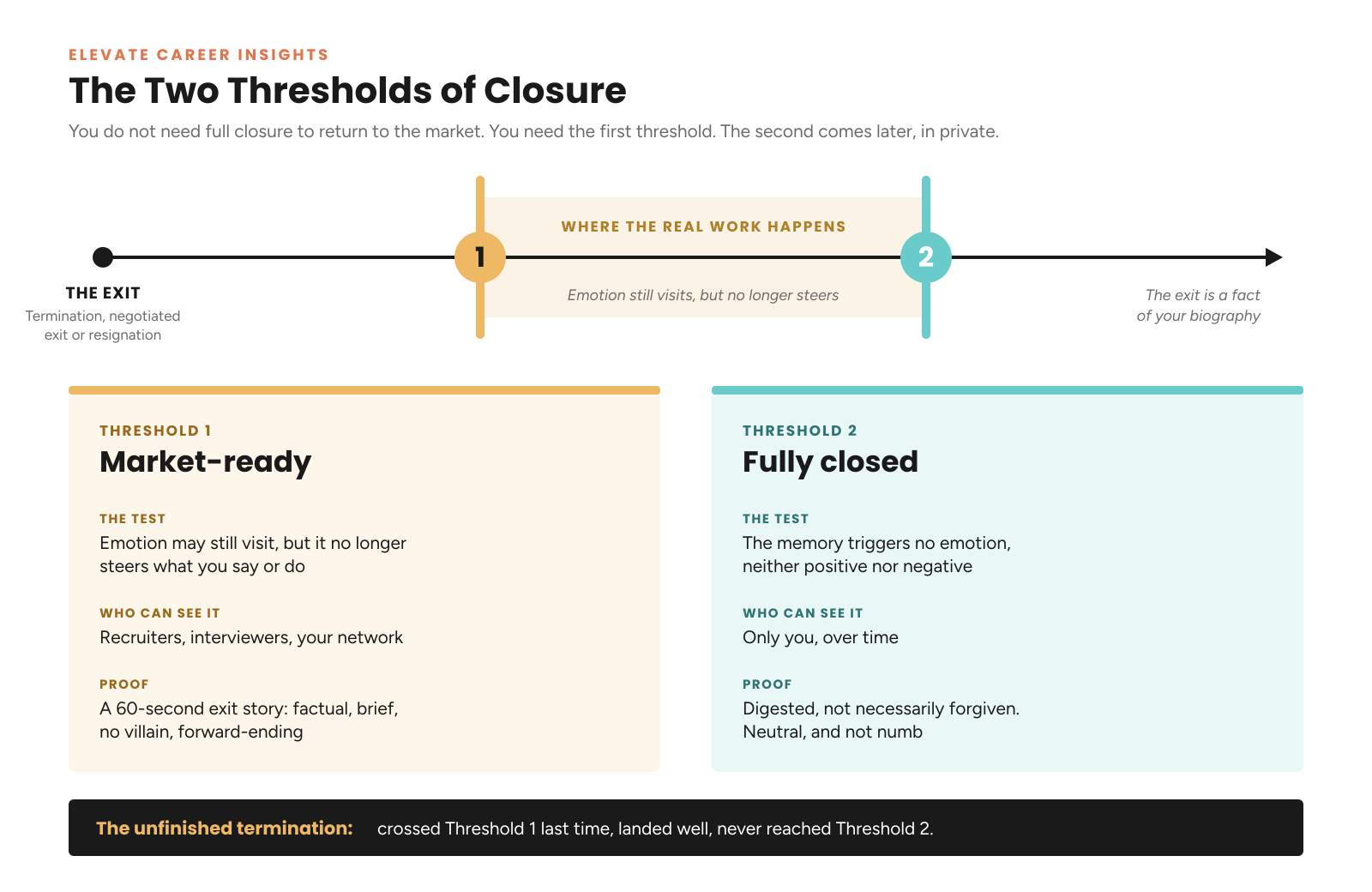
ELEVATE FRAMEWORK — The Two Thresholds of Closure Closure after an exit is reached in two steps. Market-ready: emotion may still visit, but it no longer steers what you say or do. Fully closed: remembering the exit triggers no emotion at all, neither positive nor negative — digested, not necessarily forgiven. Only the first is required to return to the market; the second comes later, in private.
The first threshold: the exit story test
From the other side of the table, unfinished grief is audible within the first ten minutes of an interview. It surfaces in the answer to the question every candidate faces: "Why did you leave?"
Interviewers listen for three things: bitterness, over-explanation and a villain. Any one of them signals a candidate still living in the previous role. The executive is evaluated less on what happened than on how they carry it.
You are market-ready when you can tell your exit story in 60 seconds, and it is:
- Factual — what happened, without adjectives.
- Brief — no defence, no appendix, no unsolicited detail.
- Without a villain — the organisation's choices are stated, not judged.
- Forward-ending — the last sentence is about what you are building next.
The second threshold: digested, not forgiven
Full closure is quieter. The exit becomes a fact of your biography, as neutral as the year you graduated. The trauma has been fully digested and absorbed — not necessarily forgiven. Forgiveness is a separate choice, and closure does not depend on it.
Two distinctions keep this threshold honest:
- Neutral is not numb. Numbness appears at the start of grief, too. Executives are skilled at suppression, and suppression looks exactly like peace from the outside. The test is depth, not brevity: can you discuss the exit at length, meet the former CEO, read the company's results — and still feel nothing?
- The event is neutral; what followed need not be. Gratitude for the chapter the exit opened is not unfinished grief. It attaches to what you built afterwards, not to the exit itself.
The gap between the two thresholds is where the real work happens. It also explains the unfinished terminations of section 03: those executives crossed the first threshold last time, landed well, and never reached the second.
STRATEGIC PROMPT Record yourself answering "Why did you leave your last role?" Play it back with the four criteria above. Then ask the harder question, alone: when you think of that day, what do you feel?
The exit is an event. The grief is work. The story is a choice.
Laurent reached the first threshold in four months and the second nearly two years later — for both exits. Hélène's turning point came when she stopped telling the agreed story to herself, even while she kept telling it to the market. Daniel gave himself permission to grieve a decision he did not regret.
None of them followed the five stages in order. All of them oscillated. And all of them reached the same place: able to remember the exit without being moved by it, and able to describe it without being defined by it.
That is the work. It is rarely fast, and it is never linear. But it is the difference between an executive who is between roles and one who is still, quietly, in the last one.
References
- Kübler-Ross, E. (1969). On Death and Dying. Macmillan.
- Kessler, D. (2019). Finding Meaning: The Sixth Stage of Grief. Scribner.
- Stroebe, M. & Schut, H. (1999). Death Studies, 23(3), 197–224. doi.org/10.1080/074811899201046
- Doka, K. J. (Ed.) (1989). Disenfranchised Grief: Recognizing Hidden Sorrow. Lexington Books.